Territoriality
West Side StoryTerritoriality in West Side Story is not merely a dispute over where a gang may walk. It is a claim to ownership, belonging, and authority over streets that offer the young people who patrol them little else they can call their own. For the Jets, the neighborhood is both hard-won property and a stage on which leadership must continually be proved. As the Sharks become a more visible rival presence, that claim expands from defending a block to imagining an empire, and ordinary urban space becomes the ground of an increasingly dangerous conflict.
Territory as Performance and Authority
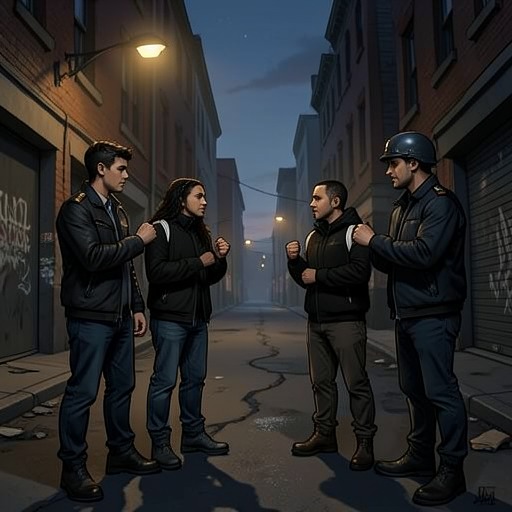
The Jets announce their control through a deliberately conspicuous way of moving. Riff sets off with his shoulders thrust out, both thumbs hooked into the large buckle of his military belt, and his eyes fixed ahead; anyone in his path is expected to move. Baby-John follows close behind, cautiously imitating him, while Action and several other Jets adopt the same posture. The gesture turns a patrol into a public performance: the gang is not simply crossing the neighborhood but displaying who expects to command it. Their readiness to attack almost anyone they encounter makes the display threatening even when no specific opponent has appeared.
Territory also governs the Jets’ internal politics. Action considers challenging Riff for leadership, but sees an advantage in leaving Riff in command: he can criticize each decision and force the leader to keep demonstrating his worth without having to take responsibility himself. The pressure on Riff to prove that he can keep the group active helps hold the Jets together and sustains their reputation among other gangs. Yet it also makes inactivity politically dangerous. During a second night of uneventful surveillance, Riff knows the restless Jets may turn their frustration against him, precisely the opportunity Action is waiting for. In this system, a leader must produce action as well as defend ground.
A Claim Forged Through Conflict
Riff recalls that the Jets fought other groups to secure their block, and that the scars he and his companions carry stand as proof that they won and held it. In his account, the neighborhood is therefore not an abstract boundary but the result of past violence, with the bodily marks of its cost serving as evidence of entitlement. The arrival of Bernardo, one of the first Puerto Ricans to move into the area, changes the meaning of that claim. Riff sees Bernardo gathering other Puerto Ricans on what he considers their territory and interprets their growing presence as an attempt to take control of the neighborhood. He imagines that, if the Sharks succeed, white residents will have to leave. His fear of displacement turns the gang’s claim into an ethnic and racial boundary, not simply a contest over particular streets.
Riff answers the perceived threat by proposing one large, decisive battle rather than continuing to endure attacks by individuals who strike and run. He tells the Jets that they fought to obtain their territory and will not stand still while the Puerto Ricans take it back. The proposal makes collective combat a means of settling ownership: victory is supposed to end the dispute and restore the street to the Jets. But the contemplated terms are already unstable. Riff is prepared to fight by whatever means the Sharks choose, including weapons, while Baby-John argues for fists or stones and against knives and guns. His appeal to a fair fight offers a limit on violence, but it also remains framed as a way to defeat and discredit the rival gang.
Riff’s territorial ambition reaches beyond defense. He imagines the street and the buildings along it, then the surrounding buildings as well, belonging to the Jets. He chooses Tony to help him enlarge this imagined domain, treating Tony’s return as a potential reinforcement of the gang’s power. The vision transforms a contested block into an expanding empire. Its scale reveals how easily the rhetoric of protecting what the Jets have won becomes a desire to claim more.
The City That Produces and Conceals the Conflict
The novel places these claims within a city already made dangerous by gang violence. It describes a thousand streets and ten thousand houses, rooftops, basements, and alleys as an immense battlefield. Before the Puerto Ricans provide the gangs with a common target, the Jets’ hostility has no precise object: they hate whatever and whoever stands in their way, and may attack people they treated kindly only the day before, acquaintances, shopkeepers who extended them credit, or even an abandoned building with an intact window. When there is nothing else to destroy, the gangs turn on one another. Territorial conflict gives this diffuse aggression a focus without curing it.
The appearance of the Puerto Ricans is therefore described with bitter irony. They provide the gangs with a target, and the city becomes safer for everyone except the Puerto Ricans. Some observers wonder what would happen if the newcomers fled or were driven out; the possibility is left deliberately unexamined while the gangs fight and retaliate, and the city continues its ordinary life while also continuing to die. This supposed improvement in safety is not a resolution. It depends on concentrating danger on an excluded group and leaves the violence-producing conditions intact.
Residents watching the Jets pass on a warm night make that failure of public order visible. Those who openly approve call out to them; others avert their eyes or hide behind a newspaper or handkerchief because the Jets mean trouble. In the densely populated neighborhood, the account suggests, trouble is already more plentiful than air, light, or hope. The residents’ avoidance leaves the gang’s territorial performance largely unchallenged in the street. The city’s geography is crowded, but the presence of people at windows and on stoops does not amount to collective protection or intervention.
Competing Meanings and the Cost of the Claim
The dispute over territory also exposes a disagreement about what the neighborhood means. For Riff, the streets are nearly all the Jets possess, and their apparent smallness makes their claim feel more, not less, precious. He insists that no one will take what he regards as his. Bernardo rejects the social performance that Riff associates with American life: he refuses to drink with people he hates and refuses to shake their hands. His refusal cuts across the conventions Riff expects, while making plain that the hostility is not a misunderstanding that a ritual of friendliness can erase. Bernardo identifies the hatred as reciprocal but unequal in degree, and will not pretend that the two groups are reconciled.
Tony’s conduct briefly challenges the boundary from within. Earlier in the evening he hides from the Jets; later he seeks them out, despite his former companions’ inability to understand why. His purpose concerns both Bernardo and Maria: he wants Bernardo to recognize that he has left the Jets because he no longer wants to fight the Sharks and that his love for Maria marks a change in the life he had shared with the gang. His effort to cross a boundary built around allegiance and territory does not make the conflict disappear, but it demonstrates that those boundaries are not identical with every individual relationship or choice.
Maria’s judgment after the deaths of Riff and Bernardo gives the territorial struggle its bleakest measure. She pities both men, recognizing that each had experienced and generated more joy and violence than seemed possible in so short a youth, yet sees no future for them while they remain caught in mutual predation. She distinguishes Tony from them because, as she understands it, he had been like them but wanted to change. The distinction does not undo what he has done or what the rivalry has cost; it makes change, rather than possession of the streets, the measure of what might have offered an alternative. Territoriality thus binds identity and group solidarity to a place, but the novel shows its claim to security collapsing into displacement fears, exclusion, and violence that the city itself leaves to continue.